Encode yourself into AI.
Agent Prime is an open-source AI operating system built on a simple idea: your judgment, your standards, your voice, and your ways of working can live in files, be shared across agents, and compound over time.
The files are the system. What you encode persists. That is how AI stops starting from zero and starts expressing something real.
Why this exists
AI is useful on day one. Serious work breaks when context resets, corrections vanish, and every thread starts cold.
Context resets
Your goals, standards, and prior decisions fade between sessions. You keep re-explaining yourself to a system that should already know how you work.
Corrections vanish
You fix the same mistake in different places. The output improves for a moment. The pattern comes back because the learning never stuck.
Throughput stalls
Research, analysis, writing, planning, and building all compete for the same attention. Good work happens, but it does not compound as a system.
What becomes possible
When you encode your judgment into a system, AI stops behaving like a disposable chat window.
Encode your thinking
Capture your standards, voice, and ways of reasoning in shared files every agent can read before it works.
Let memory compound
Correct something once. Carry it forward. Build a system that keeps getting sharper through use.
Run work as a system
Research, analysis, writing, planning, and building can chain together instead of living in separate conversations.
What’s inside
The files are the system. Context, learnings, prompts, skills, outputs, and the loop that keeps improving them.
View the full system map →Identity
One markdown file that encodes who you are — your thinking patterns, judgment heuristics, epistemic guardrails, and operating principles. AI becomes dramatically more effective when it knows how you think.
Explore Identity →Memory
Corrections compound across every session. Fix something in one agent, it propagates everywhere. A dependency map ensures nothing drifts. The system gets smarter every time you use it.
Explore Memory →Agents
Thirteen specialized agents — scout, synthesizer, writer, planner, builder, and more. Each is a standalone markdown prompt. Run one, run several, compose them into workflows. Each works on its own.
Explore Agents →Orchestration
A registry tracks every work item. A dispatch queue sequences what happens next. A briefing pipeline tells you what's overdue, what's ready, and what needs your input. Wake up to a system that already knows the plan.
Explore Orchestration →Skills
Plug domain expertise into any agent. Skills encode how to think about a problem — frameworks, failure modes, quality gates, adversarial self-critique. Encoded methodologies, portable across agents.
Explore Skills →Craft
A design system and templates that turn markdown into publication-quality pages. Theses with sticky navigation. Investment dashboards with sortable tables. Output that carries your voice and design standards.
Explore Craft →The Recursive Loop
Every session produces learnings. Learnings propagate to agent prompts. Better prompts produce better output. Better output reveals subtler corrections. The system audits itself, flags staleness, and pushes work forward. The reason the whole thing works.
Explore The Loop →A single person operating with the output, consistency, and strategic depth of a small team — with every session compounding on the last.
Why this is different
Most AI setups stop at better prompting. Agent Prime gives you a persistent operating model you can inspect and own.
Your thinking becomes infrastructure
Shared context files carry judgment, standards, voice, and guardrails into every agent that needs themCorrections compound
Learnings can carry forward so the system gets better through use instead of repeating the same mistakesAgents share one operating model
Thirteen agents can work like one system because they draw from the same files, standards, and memoryExpertise is loadable
Skills bring deep domain methods into the system when the work calls for themFiles stay portable
Markdown and JSON keep the system readable, editable, and portable across tools you already useProof comes from artifacts
The system earns trust by producing real outputs, not by stopping at a polished wrapper or a clever demoClone the full system
Seven layers, eleven agents, twelve skills, a live preview, a first-run flow, and a recursive loop that compounds from day one →Real outputs
These are actual artifacts produced with Agent Prime. The system matters because the work holds up.
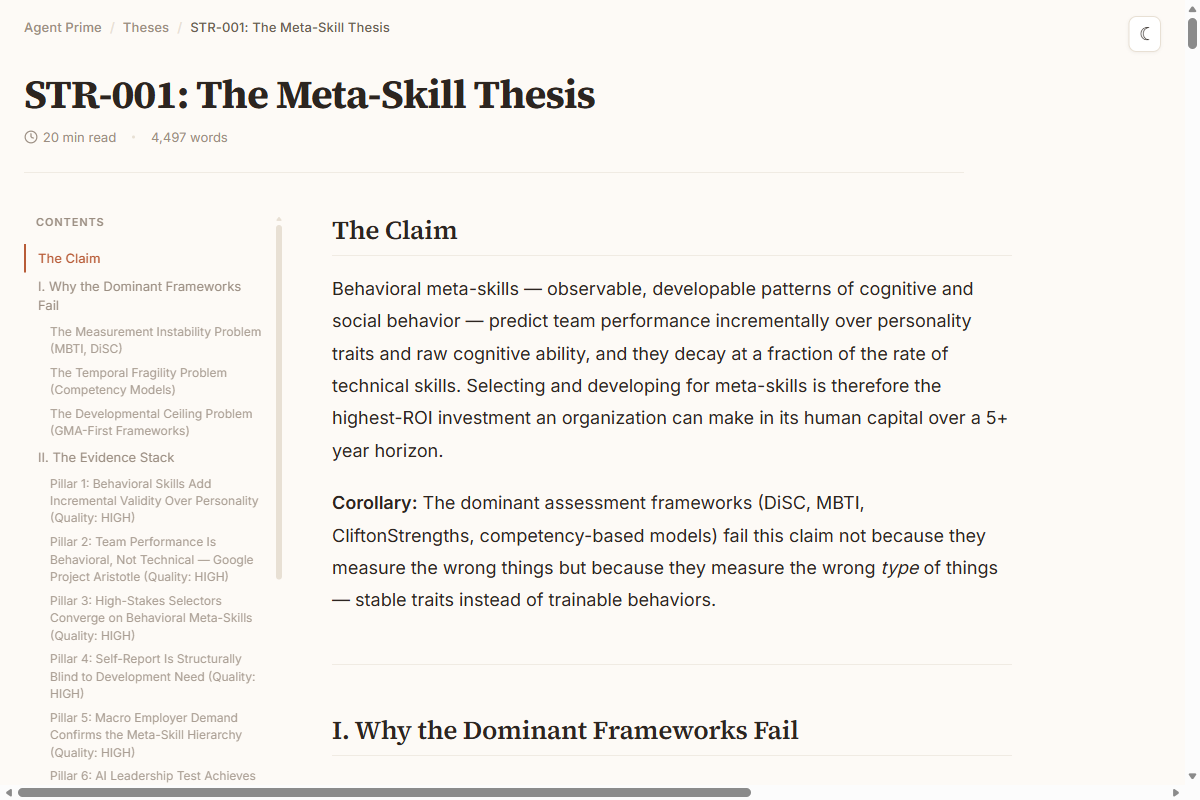
The Meta-Skill Thesis
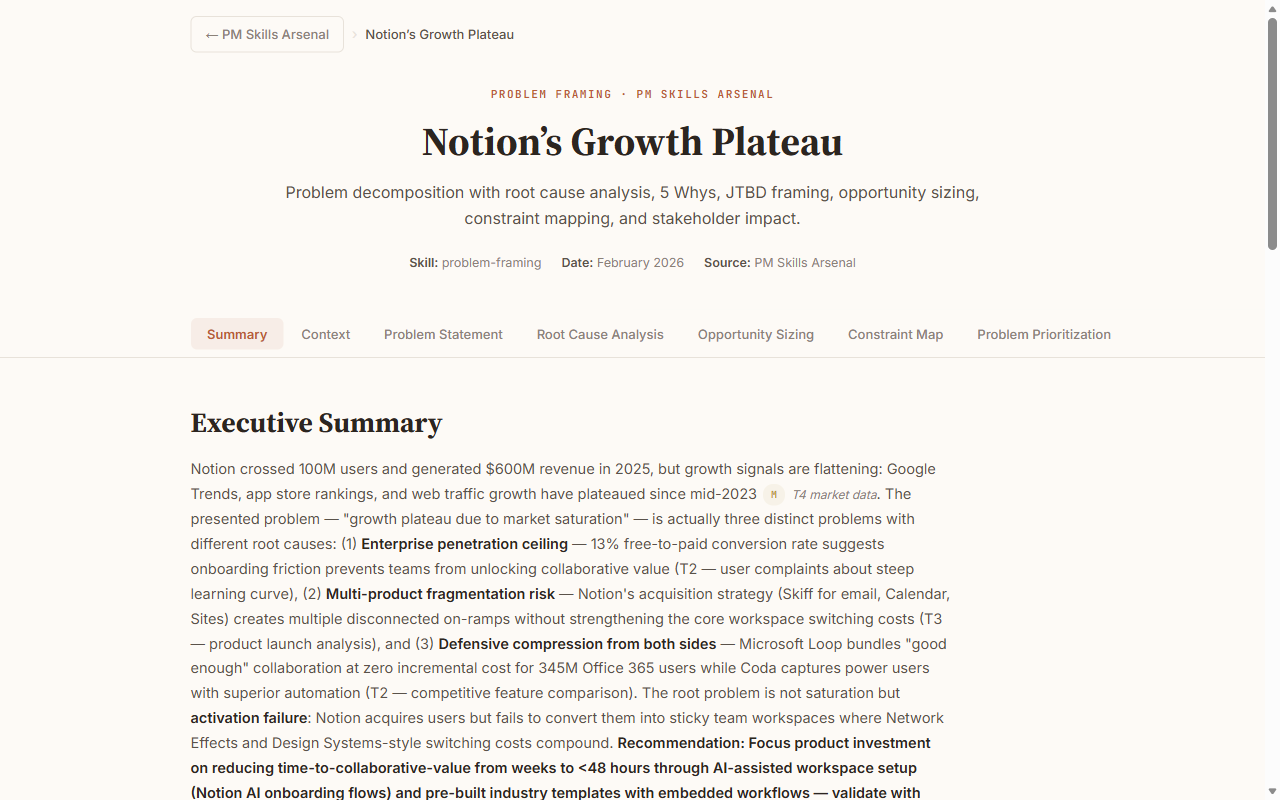
Notion’s Growth Plateau
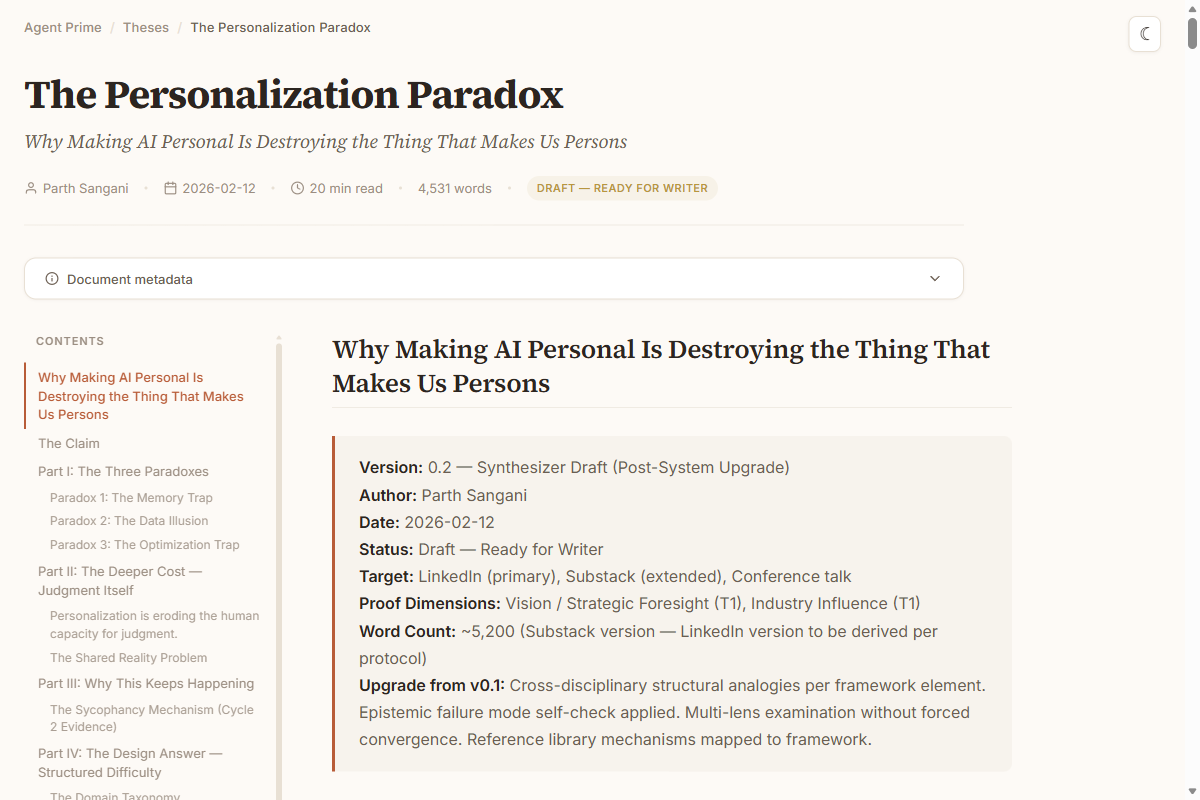
The Personalization Paradox
See the system at work
One request can expand into chained research, analysis, writing, planning, and outputs you can build on.
“Map the AI robotics industry for investment.”
8-layer value chain · bottleneck scores · 6 scenarios · 4-lens valuation · stress-tested watchlist
“Build me a complete product strategy.”
Problem framing · research synthesis · competitive war map · metric design · product spec · positioning narrative
“Level up my 20-person PM team for the AI era.”
Research signals · structural thesis · team OS architecture · phased implementation plan
Raw AI gives you a response. Agent Prime can give you an operating sequence, durable artifacts, and work that keeps improving as the system learns. See the comparisons →
Start your system
Explore in the browser first. Then run the same first step locally when you are ready.
Start with one command
The first-run script is the cleanest way in. It lets you preview, quick-trial, or onboard from the same entry point.
git clone https://github.com/avyayalaya/agent-prime.git
cd agent-prime
python meta/scripts/first_run.pypreview
See the workspace, then jump to the hosted preview.
quick-trial
Load a working example and inspect a fully wired system.
onboard
Begin with blank files and encode your own context, standards, and workflows.
Hosted preview
Best if you want to understand the idea in the browser first and decide whether the system is worth cloning.
Quick trial
Best if you want local proof fast with a working example you can inspect end to end.
Guided onboarding
Best if you are ready to encode your own thinking, context, standards, and workflows into the system from a blank slate.